So proud of my SAC team for leading this important conversation Access Denied: A SAC round table on disability justice and institutional critique at CAA this February
Gina T. Washington, Renée Lynn Reizman, Alexander Bostic and Tamryn L. McDermott
Saturday, February 21, 2026, 11:00 AM - 12:30 PM
Hilton Chicago - Lower Level - Salon C-4 (Hybrid)
The CAA Service to Artists Committee presents a round table discussion that expands upon what scholar Amanda Cachia calls “access aesthetics,” or “creative access or access as praxis. This is a genre and an art movement that centers access as a medium that contemporary disabled artists use as a political strategy” (Cachia, 2025, p. 8). As art institutions expand their platforms for disabled artists, they must also confront their limitations. Despite federal policies like the Americans with Disabilities Act, many arts organizations lack adequate accommodations for artists with physical and intellectual disabilities. This positions artists as the experts on accessibility, and makes them responsible for more labor, financial contributions, and aesthetic considerations.
Through access aesthetics, disabled artists often turn to institutional critique while participating in arts programming, such as calling out infrastructural limitations, the absence of accommodation offerings, and lack of knowledge or training among staff. We’ve seen this through Jaklin Romine’s performance series, “ACCESS DENIED,” where she positions her body outside of organizations that are inaccessible to wheelchair users. Actions like these demonstrate how disabled artists become advocates for themselves and others who share their experience.
This round table calls for participants who have studied the unique abilities disabled artists and creatives have employed to open access to institutional spaces, often not designed to meet the needs of disabled artists and visitors. We especially encourage submissions from disabled artists and scholars.
Cachia, A. (2025). The Agency of Access: Contemporary Disability Art & Institutional Critique. Temple University Press.
Hospital Aesthetics: Disability, Medicine, Activism
Amanda Cachia Arizona State University
Hospital Aesthetics: Disability, Medicine, Activism argues that contemporary disabled artists are offering a new hospital aesthetics, taking health and care into their own hands and body-minds. Hospital aesthetics is defined as artwork that explores the ever-subjective experience of being sick and ill, set apart from and outside of a clinical and therapeutic setting, and in opposition to the medical model of disability. This hospital aesthetics is not interested in art therapy’s theoretical concern with the well-being of hospital patients, but rather, it wants to challenge the oppressive master narratives within the medical model of disability, a philosophy in which disability is bad and must be fixed or corrected. In doing the work of hospital aesthetics, contemporary disabled artists are contributing to a type of disability activism that can improve both mainstream bioethics and ableist museum and gallery culture. This is because the work of contemporary disabled artists extends the imperative of decolonizing the gallery into the act of decolonizing the hospital; the artists I examine work against the medical industrial complex’s tendency to treat disabled bodies as specimens and, eventually, archives. Instead, their hospital aesthetics shows a different side to disabled bodies that attempts to undo the social and cultural impacts the hospital has had on its disabled patients, both historically and in the contemporary moment.
For Dear Life: Disabled Artists and Art Workers in Museums
Jill Dawsey
For many people with disabilities or chronic illness—including myself—museums are exclusionary spaces. As curator of the exhibition For Dear Life: Art, Medicine, and Disability (2024-25, MCASD) and an instructor of a graduate seminar on this subject at UCSD in fall 2025, I approach disability justice and institutional critique from multiple positions. As a participant in the SAC roundtable, I would be excited to discuss my personal experiences, along with key historical moments when disability justice and institutional critique intersected. In the early 1990s and 2000s, Bob Flanagan and Sheree Rose presented the landmark traveling exhibition Visiting Hours at venues on the West and East coasts; James Luna’s installation AA Meeting/Art History (1990–91) placed museum audience members in an AA meeting (a 12-step approach to decolonization); Liz Young’s The Birth/Death Chair with Rawhide Shoes, Bones and Organsappeared in the artist’s 1993 solo exhibition and performance at the Los Angeles County Museum of Art; and Stephen Lapthisophon’s absurdist installation With Reasonable Accommodation (2002) at Gallery 400 at the University of Illinois, Chicago—inspired by the gallery’s nonfunctioning elevator—questioned the access supposedly guaranteed by the ADA. A new wave of disability justice and institutional critique emerged twenty years later in the work of Park McArthur, Carolyn Lazard, Simone Leigh, LaToya Ruby Frazier, and many others, often in dialogue with predecessors such as Flanagan. In our current moment, when museums are moving away from the language of “diversity, equity, and inclusion,” access is a term and a praxis we can insist on and expand.
Access as Method: Hybrid Perception and Art Thinking in Multisensory Museums
Jeong Han Kim Seoul National University
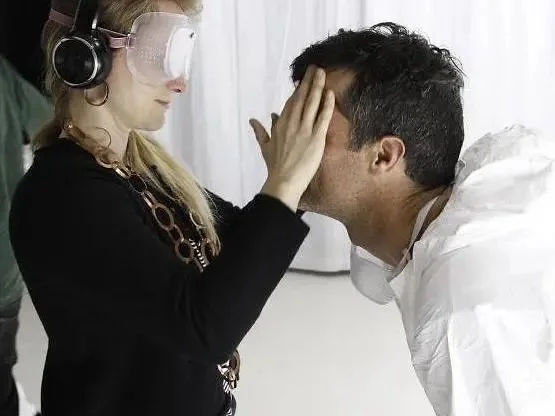
This study explores an empathetic, new media–based approach that enables both visually challenged and sighted individuals to experience artworks together through sensory translation, using the Eye and Mind workshop as a case study. It examines how issues of accessibility can lead to new aesthetic experiences through multisensory translation and collaborative creation. This study aims to analyze and theoretically examine the data collected in workshops.
The Eye and Mind workshops at the SNU Woosuk Gallery and the Clark Art Institute were grounded in 4E cognition (embodied, embedded, enacted, extended). The workshops proceed in five stages. It first uses MR to simulate the visually impaired participant’s vision for sighted users, then records and analyzes their dialogues. Next, the participant creates VR gestural drawings that are saved as 3D models and 3D-printed as haptic surrogates. Finally, we apply the same process to AI–human interactions and compare them with human–human communication. Through hybridizing other people’s perceptions, we can open new eyes for art thinking. Efforts to engage with others’ perceptions in art museums are not acts of charity or benevolence—they are acts that expand our own limited vision and field of thought. They are, ultimately, for myself.
Acknowledgments
Jeong-Han Kim (Professor, Department of Painting, SNU [Seoul National University]; 2025 Clark Futures Fellow) / Co-authors: Hyun-Jean Lee (Professor, Yonsei University), Dong-Hyun Jo (Associate Professor, Ophthalmologist, SNU), Hong-Gee Kim (Professor, SNU) / Assistants: Eun-Jae Lee, Seung-Chul Hyun / Supported by SNU (0464-20250011), the Clark Art Institute, Williams College, MMCA Korea, and the NRF of Korea (NRF-2024S1A5A2A01020340).
Strategies for Finding Common Ground on Accessibility
Anna Brody
Opulent Mobility asks artists and audience members to re-imagine disability as opulent and powerful. The exhibits began in 2015 and include artists from across the United States and from Taiwan, Belgium, the UK, Ireland, Finland, Australia, India, and Serbia. Opulent Mobility brings disability art into the fine arts world, gives opportunities to disabled artists, and starts conversations between disabled and able bodied folks about creating a more equitable world for us all.
During the exhibit’s 10 year history, it has been hosted in multiple venues and there are challenges each time, particularly in finding accessible venues that value disabled art and artists with a variety of access needs. The goal with each new exhibit is to add more layers of accessibility, which sometimes creates conflict with venue owners, organizers, and planners. Since the first show, I have developed methods to effectively collaborate with organizers while still giving the artists as much of what they need as is possible and (mostly) staying on budget.